
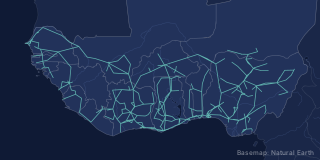
Nodal production cost model of the 14-country pool, run for every hour of 2027.
- Buses
- 665
- Branches
- 747
- Countries
- 14
- Results
- Client portal
Models
The Institute builds nodal and zonal power-system models from public data. Each regional model runs on OPEN-PCM, a shared engine for hourly production cost, capacity expansion and transmission planning.
Architecture
Every model follows the same sequence. Public inputs are assembled into a network, the fleet is dispatched hour by hour, and expansion runs test new generation, storage and transmission against that dispatch. Results are published to a secure client portal.
Programme
Maps plot each model’s buses and lines at their real coordinates; basemap from Natural Earth (public domain). Model results are available to clients through the portal.
Nodal production cost model of the 14-country pool, run for every hour of 2027.
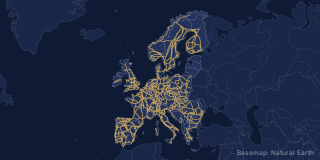
Nodal market model of the European grid at 380 kV and above, run hour by hour over a full test year.
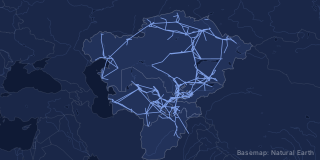
High-voltage nodal network for Kazakhstan, Uzbekistan, Kyrgyzstan, Tajikistan, Turkmenistan and Afghanistan, with the CASA-1000 link to Pakistan. The network is built and tested, and the first solves are scheduled.
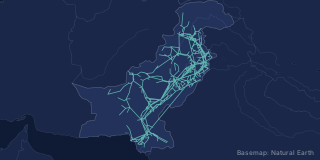
Substation-level model of the NTDC and K-Electric systems at 500, 220 and 132 kV, including the Matiari–Lahore HVDC link.
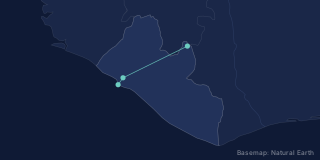
Integrated least-cost expansion and dispatch model for Liberia, developed by the Institute on OPEN-PCM and solved with HiGHS. It supports price-discovery and master-plan studies.
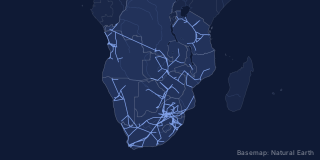
Hourly model of the twelve-country pool, run for every hour of 2024. A zonal version splits South Africa into nine transmission zones; the substation-level nodal version, 2,237 buses mapped from public data, now has a full-year run.
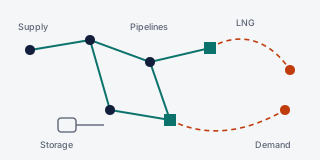
Monthly nodal model of the global gas network on OPEN-PCM conventions: pipelines, LNG liquefaction, shipping and regasification, and storage, with scenarios for 2026–2035.
TEI’s open-source core production cost model: hourly nodal dispatch with DC power flow, line losses, thermal fuel costs and wind and solar profiles, solved as one sparse linear programme with the open-source HiGHS solver. MIT licensed, Python.
Approach
Inputs come from system operators, regulators, statistics agencies, multilateral lenders and open map data. Each series is recorded with its source.
Models use open-source solvers, and every dataset can be rebuilt from its original download.
Where no open source exists, the gap is logged and a documented class value is used until better data is found.