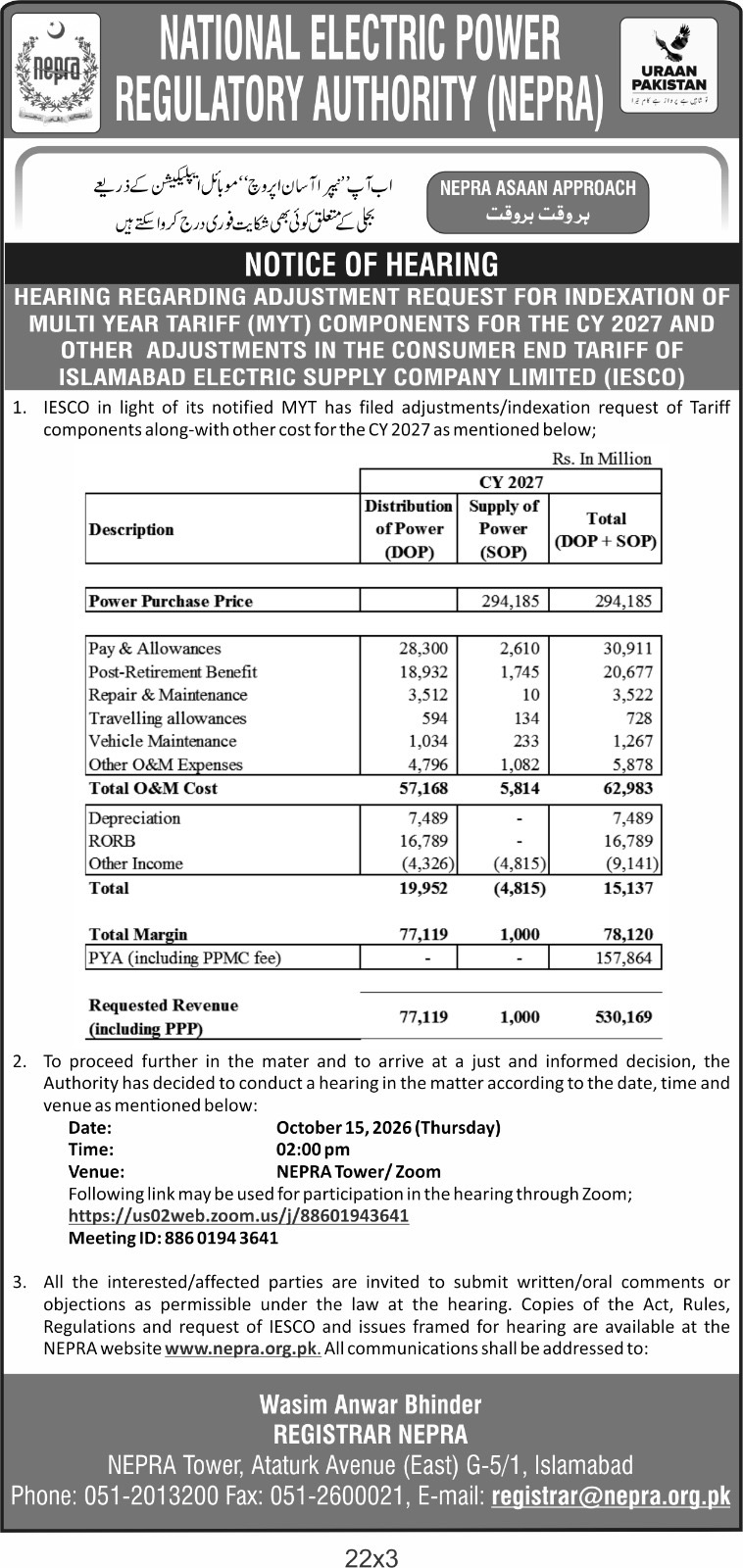
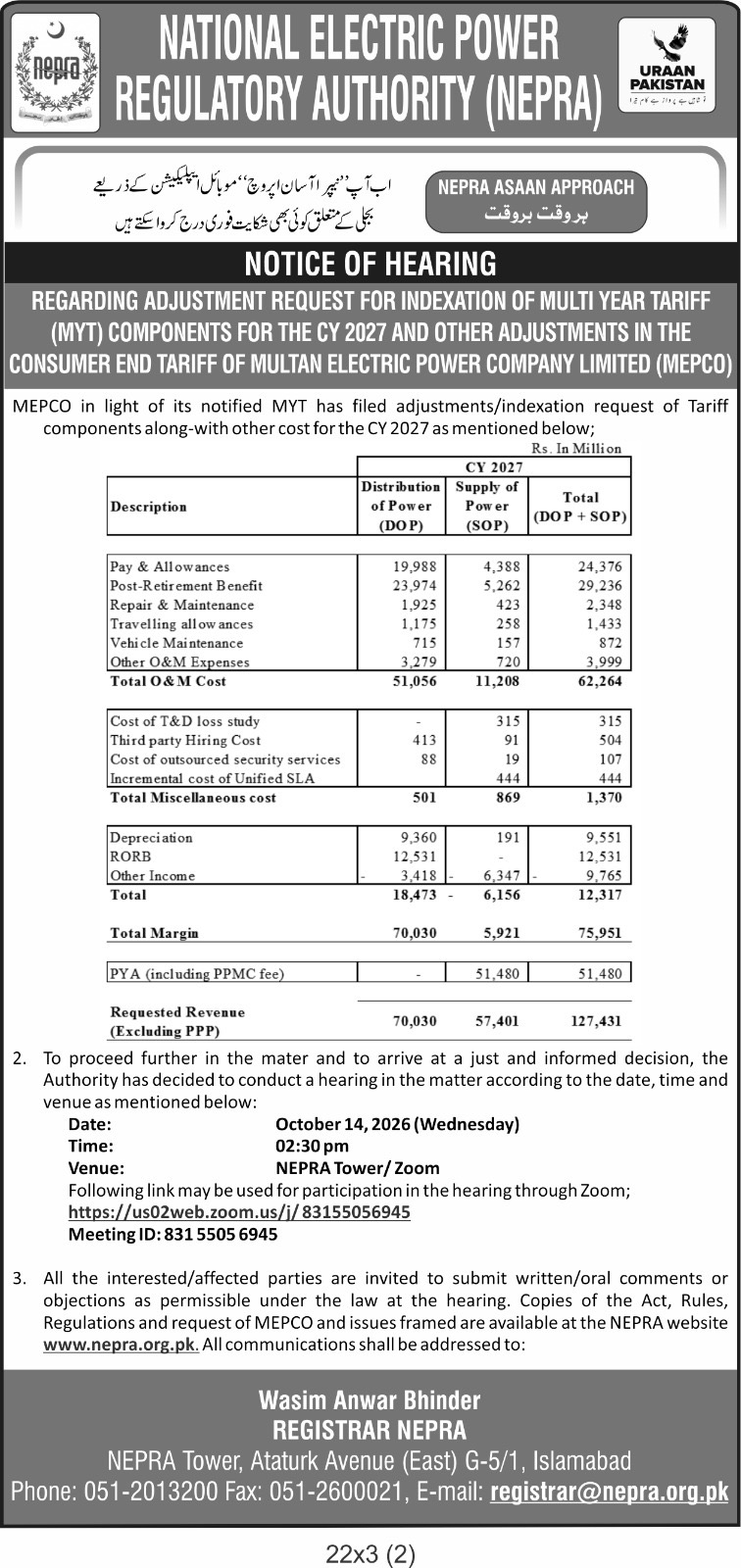
Each autumn the ten ex-WAPDA distribution companies (XWDISCOs) file for indexation of their distribution and supply margins and for a prior-year adjustment (PYA), the true-up that recovers costs the last tariff did not cover. The filings for calendar year 2027 went to NEPRA in September and were heard between 13 and 15 October 2026. NEPRA's hearing notices list the PYA requested by each company, including the fee for the Power Planning and Monitoring Company (PPMC). Added together, the ten requests come to Rs415,302 million.
One company accounts for 38% of that. The Islamabad Electric Supply Company (IESCO) asks for Rs157,864 million, roughly twice its own requested CY2027 margin of Rs78,119 million. The next largest are FESCO at Rs56,973 million and MEPCO at Rs51,480 million. HESCO's request is the smallest at Rs7,019 million.
PYA requested for CY2027, as listed in NEPRA's notices:
- IESCO: Rs157,864 million
- FESCO: Rs56,973 million
- MEPCO: Rs51,480 million
- SEPCO: Rs36,296 million
- LESCO: Rs32,783 million
- PESCO: Rs22,556 million
- QESCO: Rs17,818 million
- GEPCO: Rs16,958 million
- TESCO: Rs15,555 million
- HESCO: Rs7,019 million
The issues NEPRA framed for every hearing include the same question: whether the requested PYA, including the PPMC fee, is justified. This piece goes through the IESCO petition line by line, sets it against what NEPRA decided on the same company's claim in June 2025, and compares it with the other two companies in the first privatisation batch, FESCO and GEPCO. TEI's calculations use the petitions and notices as filed. None of these numbers are determined tariffs.
What sits inside IESCO's Rs157.9 billion
The IESCO petition, dated 11 September 2026, lists 22 items. Several are routine. Consumer mix variance, the revenue lost because sales shifted toward lower-tariff categories, adds Rs5,566 million for FY2024-25 and Rs12,626 million for FY2025-26. Shortfalls against allowed salaries and post-retirement benefits add another Rs16,470 million over the two years. Minimum tax is Rs4,536 million. A few items run the other way, such as depreciation, return on rate base and FY2025-26 other income.
Four items are of a different kind, and together they make up most of the claim.
- Supplemental charges billed by CPPA-G for FY2022-23 to FY2025-26: Rs29,885 million.
- Actuarial remeasurement losses on post-retirement obligations, recognised in other comprehensive income (OCI) in FY2023-24, FY2024-25 and FY2025-26: Rs47,951 million, of which Rs48,113 million is pension and the rest small offsets.
- Income tax and sales tax settled through the Alternative Dispute Resolution Committee (ADRC): Rs31,506 million, covering 35 cases with tax periods going back to July 2009.
- Non-recoverable duties and taxes on imported material for the advanced metering infrastructure (AMI) project: Rs9,314 million.
By TEI's calculation the four come to Rs118,656 million, or 75.2% of the claim. The AMI item has a different footing from the others. NEPRA's review decision circulated on 24 January 2025 said it would allow taxes and duties on the AMI project as per actual, subject to evidence, so the open question there is documentation. Leaving AMI aside, the other three heads total Rs109,342 million, 69.3% of the PYA and Rs9.12 for every unit IESCO expects to sell in CY2027.
On IESCO's projected sales of 11,983 million kWh, the whole PYA works out to Rs13.17 per unit. In the petition's own tables, the revenue requirement for FY2027-28, which carries no PYA, is Rs30.52 per unit. CY2027, with the PYA, is Rs43.54.
The two items NEPRA refused last year
IESCO asked for most of this once before. Its petition for the FY2025-26 indexation claimed a PYA of Rs41,680 million, or Rs3.59 per unit. That figure included the FY2023-24 actuarial OCI loss of Rs34,040 million and supplemental charges in excess of late payment surcharge (LPS) of Rs3,884 million for FY2022-23 and Rs5,594 million for FY2023-24.
NEPRA's decision of 23 June 2025 allowed a total PYA of Rs6,144 million, 14.7% of the request. On supplemental charges, it held that these are not allowed as a separate item because the XWDISCOs keep the late payment charges they collect from consumers to offset them. On the actuarial loss it said the claim did not merit consideration, noting that the shortfall in post-retirement benefits actually paid had already been allowed.
Both items are back. The FY2023-24 OCI loss of Rs34,040 million appears again, unchanged, now joined by two later years. The supplemental charges for the same two years are now claimed on a gross basis: Rs6,867 million for FY2022-23 and Rs10,647 million for FY2023-24, a combined Rs17,514 million against the Rs9,478 million claimed net of LPS last year. The petition does not deduct LPS from any of the four years. Taken together, the supplemental charges and actuarial losses NEPRA ruled on in June 2025 are Rs77,836 million of the new claim, 49.3% of it and Rs6.50 per unit of IESCO's sales.
The petition explains what changed on IESCO's side. "In connection with IESCO's inclusion in Batch I of the privatisation programme," it says, correspondence from the Ministry of Privatisation and the Ministry of Energy dated 22 May 2025 addressed recognition of supplemental charges, and the Financial Advisor on the transaction called for outstanding disputes to be resolved and unrecorded charges recognised. IESCO has booked the liabilities and is asking for them to be recovered through tariff. The ADRC settlements were charged to expense in FY2024-25 and FY2025-26 and carry a similar description: longstanding disputes settled so that the accounts reflect them.
FESCO and GEPCO tell the same story, at a different size
FESCO and GEPCO, the other two companies in the batch that the Privatisation Commission Board took to the Cabinet Committee on Privatisation in July, both cite the same instruction. FESCO quotes a Ministry of Privatisation and Ministry of Energy letter of 11 October 2024 asking DISCOs to book supplemental charges, and the Financial Advisor's view that long-outstanding disputes and unbooked supplemental charges must be resolved. FESCO booked Rs11,348 million with board approval. Of that, Rs6,186 million relates to FY2010-11 to FY2013-14, which NEPRA disallowed in its December 2015 determination, and Rs5,163 million is the excess over LPS for later years. FESCO describes the step as having "contributed to a cleaner and more transparent balance sheet."
GEPCO cites the Power Division's letter of the same date and has booked Rs6,711 million of supplemental charges for FY2009-10 to FY2014-15, previously disallowed by NEPRA. CPPA-G then issued credit notes of Rs2,593 million, so GEPCO's net claim is Rs4,118 million. GEPCO's petition also follows the existing mechanism for the current year, deducting Rs1,740 million because the LPS it collected from consumers in FY2025-26 exceeded what CPPA-G billed it.
Across the three companies, TEI counts Rs45,351 million of supplemental charges in the CY2027 claims. IESCO's is the largest by a wide margin, and it is the only one of the three that presents the charges gross for recent years.
The other legacy items differ by company. FESCO asks for Rs14,407 million of post-retirement benefit provisions above amounts allowed between FY2015-16 and FY2025-26, Rs5,318 million receivable from WAPDA for pensioners who retired before 1 July 1998 (which WAPDA has declined to settle), and Rs2,698 million of fuel charges notified for November 2019 to June 2020 that were never billed. FESCO also tabulates Rs65,367 million of actuarial OCI losses since FY2015-16 but leaves them out of its PYA total, asking instead that NEPRA consider a mechanism for recovering such remeasurements gradually in future. GEPCO's claim includes Rs4,134 million of sales tax demands settled through the ADRC and Rs712 million of PPMC fees for FY2013-14 to FY2024-25.
On each company's own projected CY2027 sales, the PYA requested is Rs3.78 per unit for FESCO (15,061 million kWh) and Rs1.46 for GEPCO (11,600 million kWh), against IESCO's Rs13.17. Among the companies whose petitions TEI could read in full, only SEPCO is higher, at Rs13.56 on 2,677 million kWh, and it is a much smaller company with a different set of problems.
Who pays under a uniform tariff
These are company-level figures, but the federal government asks NEPRA for a single national schedule of consumer tariffs, so the ten revenue requirements are ultimately recovered through common rates and the subsidy that balances them. TEI's 5 October research looked at how that arrangement fits with privatisation. One way to see the size of the claims is to spread them across all the energy CPPA-G expects to supply the XWDISCOs. CPPA-G's power purchase price report for CY2027 puts that at 130,081 million kWh in its base case, at a projected average price of Rs27.309 per unit, or Rs3,552,439 million in total.
By TEI's calculation, the ten PYA requests equal Rs3.19 per unit of that supply and 11.7% of the projected power purchase bill. IESCO's request alone is Rs1.21 per unit. The three first-batch companies together come to Rs1.78, and their supplemental charges alone to Rs0.35. These are crude averages that ignore losses, the split between fixed and variable charges and the timing of any recovery, but they show that IESCO's request is large relative to the national tariff as well as to its own.
What NEPRA is being asked to decide
The privatisation process has created a reason to clean up these balance sheets that did not exist before. The Privatisation Commission's July plans for FESCO, GEPCO and IESCO, covered in TEI's 28 July piece, were built around a government-owned special purpose vehicle that would take selected assets and liabilities off the companies' books before sale. The commission has not published which liabilities move to it. The CY2027 petitions show the companies taking a parallel route for some of the same items, booking them in their own accounts and asking NEPRA to recover them through the tariff.
For NEPRA, the question raised by IESCO's petition is whether a direction from ministries and a transaction adviser to recognise a cost is a reason to change its own view of whether consumers should pay it. The regulator's June 2025 reasoning on supplemental charges rested on the LPS offset, which has not changed. Its reasoning on the actuarial loss rested on the fact that benefits actually paid were already allowed, which is also unchanged.
NEPRA has not yet issued determinations on the CY2027 petitions. Once it does, the federal government will file its uniform tariff motion, and the amount allowed for IESCO's prior years will show up in that motion as one input among many.